


For millions of people, the days leading up to their period are a predictable and unwelcome challenge. We call it PMS, or Premenstrual Syndrome, a term that somehow feels too clinical and too simple for the profound, full-body experience it represents. It’s not just the physical discomfort—the cramps, the debilitating bloating, the breast tenderness, the sudden acne flare-ups. It’s the other side of the coin: the overwhelming fatigue that makes your limbs feel like lead, the “brain fog” that descends, the emotional volatility, the irritability, and that “run-down” feeling, as if you’re on the verge of getting sick.
For too long, these symptoms have been dismissed as just a “normal” part of being a woman, something to be endured with a painkiller and a hot water bottle. But this experience is not a personal failing or “all in your head.” It is a complex, physiological event.
The truth is that PMS is not a single issue. It is a dual-problem:
- A Hormonal Imbalance: A complex miscommunication in your body’s signaling pathways, specifically involving inflammatory compounds.
- A Nutritional Depletion: A systemic crash in the key vitamins and minerals your body needs to manage stress, create energy, and support your immune system.
When you’re fighting a two-front war, you need a two-part solution. You can’t just address the cramps and ignore the fatigue. You can’t just pop a multivitamin and ignore the underlying hormonal static. This article will dive deep into the science of these two problems and explore a modern, holistic approach to finally addressing them both.
Part 1: The Hormonal Story – The Prostaglandin Imbalance
When we talk about PMS, we often blame our primary hormones, estrogen and progesterone. And while their fluctuation in the luteal phase (the time after ovulation and before your period) is what kicks off the process, they aren’t the direct culprits for your pain and discomfort.
The real players, in many cases, are a group of powerful, hormone-like compounds called prostaglandins.
What Are Prostaglandins and What Do They Do?
Prostaglandins are fascinating. Unlike hormones, which are produced by a gland and travel through the bloodstream, prostaglandins are made by nearly every cell in the body, and they work locally. They are short-lived, powerful signalers that tell your body how to react to its immediate environment.
They are critical for many functions, but for our purposes, they control three things:
- Inflammation: They can either create it (as a healing response) or reduce it.
- Muscle Contraction: They tell smooth muscles (like your uterus) when to contract and when to relax.
- Blood Vessel Dilation/Constriction: They control blood flow.
Sound familiar? These three functions—inflammation, muscle contraction, and blood flow—are the very definition of a period. The problem is not that prostaglandins exist; the problem is that they get out of balance.
The “Good” vs. The “Bad”: How Prostaglandins Cause PMS
To simplify a complex process, you can think of your prostaglandins in two main groups:
- Pro-inflammatory Prostaglandins (The “Bad Guys”): These are derived from a fatty acid called Arachidonic Acid (AA), found in foods like red meat and dairy. These prostaglandins (like PGE2) are built to create inflammation, cause intense muscle contractions, and constrict blood vessels. In excess, they are the direct cause of agonizing cramps, breast tenderness, and general aches and pains.
- Anti-inflammatory Prostaglandins (The “Good Guys”): These are derived from a different fatty acid pathway. The most important one for us is PGE1. This “good” prostaglandin is a powerhouse of relief: it is strongly anti-inflammatory, it helps relax smooth muscles (easing cramps), and it dilates blood vessels to improve blood flow.
PMS, at its physical core, is often a state of prostaglandin imbalance: your body is producing far too many “bad” inflammatory prostaglandins and not nearly enough “good” anti-inflammatory ones. Your system is flooded with “contract, inflame, tense up” signals and is starved of the “relax, calm down, anti-inflame” signals.
So, the logical question is: how do we get more of the “good” ones? We do it by giving our body the one ingredient it needs to make them.
The GLA Connection: Your Body’s Natural Peacemaker
The “good” anti-inflammatory prostaglandin, PGE1, is made from an essential omega-6 fatty acid called Gamma-linolenic acid (GLA).
GLA is the direct precursor, the raw material, for your body’s own natural, built-in PMS defense. When you have sufficient levels of GLA, your body can ramp up its production of PGE1, effectively telling the uterus to relax, the inflammation to cool down, and the breast tissue to be less tender. GLA has also been studied for its ability to support skin health (another PMS casualty) by improving the skin’s moisture barrier.
This sounds like a simple fix, right? Just get more GLA. Unfortunately, there’s a major roadblock.
The Conversion Problem: Why We’re All Deficient in GLA
You might be thinking, “I eat plenty of healthy fats. Why am I deficient?”
Here’s the problem: Your body is supposed to make its own GLA from a more common omega-6 fat, Linoleic Acid (LA), which is abundant in nuts, seeds, and vegetable oils. However, the conversion of LA into GLA depends on a single, crucial enzyme called Delta-6-Desaturase (D6D).
This D6D enzyme is incredibly sensitive and is easily blocked or “slowed down” by modern life. The most common D6D inhibitors are:
- Stress: The stress hormone cortisol is a powerful inhibitor.
- Alcohol: Even moderate consumption can slow it down.
- Poor Diet: Trans fats and excess sugar are major culprits.
- Nutritional Deficiencies: Your body needs B-vitamins, Zinc, and Magnesium to make this enzyme work—the very nutrients that get depleted during PMS (more on this in a second!).
This means that even if you are eating a “perfect” diet, the stress of a busy life alone can be enough to prevent your body from making the GLA it needs to fight inflammation.
The only way to solve this is to bypass the broken conversion pathway. You must get your GLA directly. This is where supplements come in. While Evening Primrose Oil is well-known, Borage Oil is by far the most potent, concentrated natural source of GLA on the planet, containing more than double the amount.
This is Part 1 of the puzzle: to balance the hormonal storm, you must calm the prostaglandin imbalance. The most effective, natural way to do this is by supplementing with a direct source of GLA, like Borage Oil.
Part 2: The Energy Drain – The Great Nutritional Depletion
Hormonal imbalance is only half the story. It explains the pain, bloating, and skin issues. But what about the crushing fatigue? The irritability? The brain fog? The feeling of being so run down you’re convinced you’re getting the flu?
This is Part 2 of the problem: severe nutritional depletion.
Why Does Your Period Make You So Tired?
The luteal phase (pre-period) is one of the most metabolically demanding times of your cycle. Your body’s resting metabolic rate can increase, and it’s working overtime. This hormonal shift requires a massive amount of micronutrient resources to manage.
Think of your body as a high-performance factory. Before your period, the factory goes into overdrive. It’s burning through its raw materials (vitamins and minerals) at an accelerated rate to manage hormone production, nerve signaling, and stress responses. By the time your period is about to begin, the “shelves” are empty. This depletion is what causes the crash.
The “Big 5” Nutrients Your Cycle Demands
While many nutrients are used, a few key players are consistently depleted, leading directly to the most-hated PMS symptoms.
-
B-Vitamin Complex (B1, B2, B6, Niacin): These are the “spark plugs” for your body’s energy-production system. They are essential for converting the food you eat into cellular energy (ATP).
- The Fatigue Link: When you’re low on B-vitamins, you cannot efficiently make energy, no matter how much you eat or sleep. This is the source of that deep, cellular exhaustion.
- The Mood Link: Vitamin B6, in particular, is critical for producing your “feel-good” neurotransmitters, serotonin and dopamine. Low B6 is directly linked to premenstrual anxiety, irritability, and low mood.
-
Magnesium: This is the ultimate “calm” mineral. It’s involved in over 300 enzyme reactions in your body.
- The Cramp Link: Magnesium is a natural muscle relaxant. It counteracts calcium, which causes muscle contractions. Low magnesium leads to more intense, painful uterine cramps.
- The Anxiety Link: It calms the central nervous system, helping you feel less “on edge” and anxious.
- The Energy Link: You need magnesium to create ATP. No magnesium, no energy.
-
Vitamin D: We think of it for bone health, but it functions more like a hormone and is critical for both mood and immunity.
- The Mood Link: Vitamin D deficiency is overwhelmingly linked to low mood and depression. This can make the “period blues” feel infinitely worse.
- The Immune Link: This is why you feel like you’re getting sick. Vitamin D is a master-regulator of your immune system. When it’s low, your defenses are down.
-
Zinc: This is a powerhouse mineral for hormonal and skin health.
- The Acne Link: Zinc is anti-inflammatory and helps regulate oil production, making it a key fighter against hormonal acne.
- The Immune Link: Like Vitamin D, Zinc is essential for a robust immune response.
- The Hormonal Link: Remember that D6D enzyme needed to make GLA? Zinc is a required cofactor! A deficiency creates a vicious cycle: low zinc -> less GLA -> more PMS.
-
Antioxidants (Vitamin C & E, Manganese): All the inflammation we discussed in Part 1 creates “oxidative stress”—cellular damage. Antioxidants are the cleanup crew.
- Vitamin C: Your adrenal (stress) glands burn through Vitamin C at a high rate. Low C = less resilience to stress.
- Vitamin E: This vitamin has been shown to be highly effective at reducing PMS symptoms, including breast tenderness, by fighting inflammation.
When you look at this list, you see the blueprint for PMS. You are fatigued, anxious, and crampy (low B-Vitamins and Magnesium) and you feel moody, run-down, and are breaking out (low Vitamin D, Zinc, and antioxidants).
Part 3: A Holistic 2-in-1 Solution for a 2-Part Problem
We have now established that PMS is a two-part problem: a prostaglandin imbalance causing physical pain, and a nutritional depletion causing fatigue, low mood, and low immunity.
For decades, the only solution was to take a handful of different pills: a painkiller for the cramps, a B-complex for energy, a magnesium pill for anxiety, and so on. This approach is expensive, confusing, and inconsistent.
A modern, functional solution must address both problems simultaneously in one simple, high-quality system. This is precisely the philosophy behind the .
This innovative 2-in-1 daily supplement is the first of its kind to combine the two necessary solutions into one daily packet. It is a clean, plant-based, GMP-certified product designed in Korea, a global leader in functional wellness.
Addressing Part 1: The Hormonal Balancer (The Borage Oil Capsules)
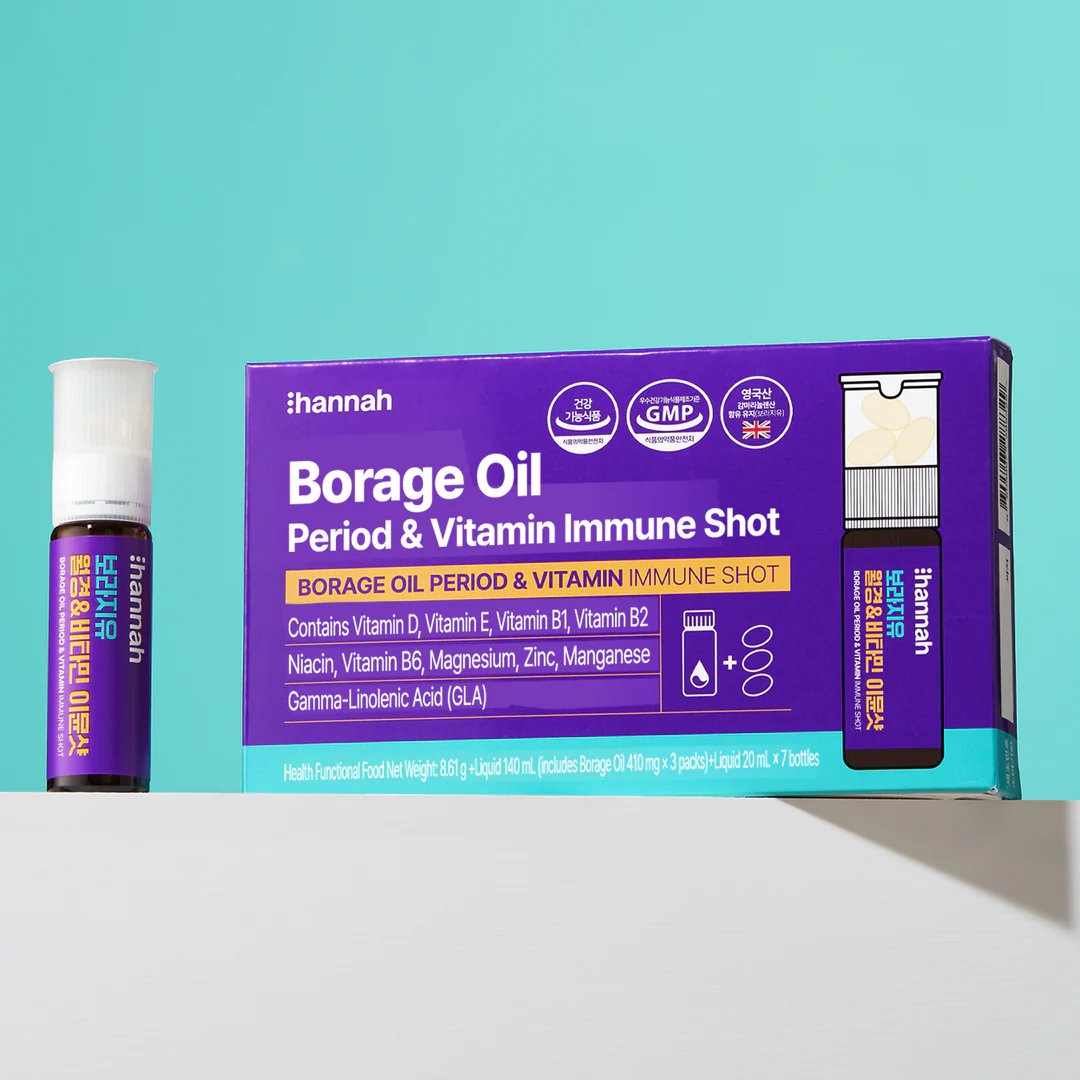
The first part of the system is a set of three 100% plant-based capsules. This is the answer to the prostaglandin imbalance.
- What it is: High-quality Borage Oil sourced from the UK.
- How it works: This is not a “maybe.” This is a direct biological solution. The Borage Oil delivers a potent, concentrated dose of GLA (Gamma-linolenic acid). This bypasses your body’s stressed-out, inefficient D6D conversion pathway and directly feeds your “good” prostaglandin (PGE1) production.
- The Result: It provides your body with the exact raw material it needs to fight inflammation, relax uterine muscles, and ease discomfort at its source. It also supports your skin barrier from within.
Addressing Part 2: The Energy Restorer (The Liquid Vitamin Shot)
The second part of the system is a 20ml liquid multivitamin shot. This is the answer to the great nutritional depletion.
- What it is: A comprehensive blend of 10 essential nutrients in a highly bioavailable liquid form.
-
How it works: This liquid shot is a targeted replenishment strategy. It’s not just a random multivitamin; it is specifically formulated with the exact nutrients your body loses during the premenstrual phase.
- Energy & Mood: It contains the B-Complex (B1, B2, B6, Niacin) and Magnesium to restore your cellular energy and calm your nervous system.
- Immunity & Stress: It is packed with Vitamins C, D, and Zinc to rebuild your immune defenses and help your body manage stress.
- Antioxidant Support: It includes Vitamin E and Manganese to protect your cells from the oxidative stress of inflammation.
- The Result: Instead of feeling depleted, your body’s nutritional “shelves” are restocked daily, helping you maintain energy, a stable mood, and a strong immune system.
How to Start Your New Holistic Ritual
This 2-in-1 system is designed for any woman who is tired of PMS ruling her life and is looking for a clean, plant-based, and functional supplement. It is for you if:
- You experience moderate to severe PMS symptoms (cramps, bloating, fatigue, mood swings).
- You need both hormonal and nutritional support before your period.
- You are looking for a convenient, high-quality, all-in-one solution.
The system is designed for simplicity: You take 1 stick (20ml) of the liquid shot + all 3 capsules daily, preferably with a meal to enhance absorption. Each box contains seven daily servings, perfect for targeted use during the week leading up to your period when symptoms are at their worst.
(Please note: This product is proudly Made in Korea. The original packaging is in Korean, but for your convenience, a full English label has been attached to the back of the box. An English version of the packaging will be released soon.)
The Future of Period Wellness is Holistic
Your body is not your enemy. The symptoms of PMS are not a punishment; they are a signal. They are your body’s way of telling you exactly what it needs.
For years, we’ve been taught to silence these signals with painkillers. The future of period wellness is about listening to them.
- The signal of pain and inflammation is your body asking for help balancing its prostaglandins.
- The signal of fatigue and anxiety is your body asking for its essential nutrients to be replenished.
You deserve a solution that is as complex and intelligent as your own body. A holistic approach means you stop patching symptoms and start supporting systems. By addressing both the hormonal imbalance with GLA and the nutritional depletion with essential vitamins and minerals, you are finally giving your body the complete support it’s been asking for.
Ready to change your relationship with your cycle?
Disclaimer: The information provided in this article is for educational and informational purposes only and is not intended as medical advice. It is not a substitute for professional medical advice, diagnosis, or treatment. Always seek the advice of your physician or other qualified health provider with any questions you may have regarding a medical condition. These statements have not been evaluated by the Food and Drug Administration. This product is not intended to diagnose, treat, cure, or prevent any disease.